
How to Buy USDT in Your Country (2026)
You want to buy USDT. OK. Simple enough, right? Open an app, tap buy, done. Except — which app? Which network? And why did the fee eat more than the price moved?
Short answer first. USDT is a stablecoin, meant to track the US dollar — one USDT, about one dollar. This guide covers how to buy USDT safely: on an exchange, from another person, or inside a wallet app. Then how to move it carefully. Right network, right address, small test first. No recommendations. No “best platform”. Just how it works, what it costs, and where people lose money.
Table of Contents
What USDT Is — and What It Is Not
USDT. Tether. A stablecoin, designed to track the US dollar — one USDT, about one dollar. People use it to move value between exchanges, to hold funds in dollars without a bank account, and to pay where the other side accepts it.
Useful. But here’s the misunderstanding — USDT is not a dollar in a bank account, and holding it is not the same as holding dollars. It’s a token, issued by a company, running on blockchains. Its value depends on the reserves and systems behind it.
It can trade slightly above or below one dollar. An exchange can pause withdrawals; a network can get congested. None of that makes it unusable — understand it before you buy, not after. For the issuer’s own description, see Tether’s own site.
Why buy it at all? Three jobs, mostly: moving money between platforms without a bank, parking funds in something dollar-like while staying inside crypto, paying someone who accepts it. That’s it. No magic.
One more thing: this guide is educational only. It won’t tell you whether to buy USDT, how much, or which platform — only how the buying works, what it costs, and what to check before you send anything.
Before You Buy: Three Checks in Your Country
Crypto rules aren’t the same everywhere, and they change — what’s straightforward in one country can be restricted, taxed differently, or unavailable in another. Before any account, check three things, for your own country.
First, whether buying USDT is allowed for you. Some countries allow crypto trading freely, some only through licensed platforms, some restrict it — and your bank may have its own rules too. A short check of your regulator’s public guidance and your bank’s terms beats any tutorial. A purchase that breaks a local rule can leave your funds frozen. Worse than a slow start.
Second, what identity checks you’ll face. Most regulated exchanges ask for identity verification — KYC. A government ID, a photo, sometimes proof of address. Normal on licensed platforms. A platform promising no checks at all for large amounts? Warning sign, not a benefit.
Third, how you’ll be taxed. In many countries, buying USDT isn’t itself a taxable event — but selling, swapping, or spending it can be. Keep your own records from the start: date, amount, price, fees, platform. Unsure about local tax rules? Ask a local tax professional. No guide can cover every country’s rules.
Three checks. Ten minutes. Do them first.
How to Buy USDT: The Four Routes
No single best way to buy USDT — the right choice depends on your country, how you want to pay, and how much control you want afterwards. Four routes most beginners meet. Each one works. Each one has a catch.
1. A centralised exchange
The most common route: create an account on a large exchange, verify your identity, deposit local currency by bank transfer or card, and buy USDT on its market. The exchange holds your USDT until you withdraw it.
Advantage? Simplicity — one place for everything, with support if the account itself goes wrong. Disadvantage? Custody. Your USDT sits on the exchange, you don’t hold the keys. Withdrawals can pause. Accounts can freeze during a review.
That’s why most guides — including the ones on this site — suggest moving funds you plan to hold into a wallet you control. What Is Rob The Coins? explains why that habit matters.
Don’t compare only the headline trading fee. Compare the full cost — deposit fee, trading fee, spread, withdrawal fee, together. Zero commission can still mean expensive, with a wide spread or a high withdrawal fee.
2. Peer-to-peer (P2P) trading
On a P2P market, you buy USDT directly from another person, and the platform holds the seller’s USDT in escrow until you’ve paid. Payment methods vary — bank transfer, mobile money, other local options — depending on the platform and your country.
P2P helps where card or bank deposits are difficult, with more payment methods. But more risk too — you’re dealing with a stranger. Only use escrow, only pay through the recorded method, never move the chat off-platform. That’s how most P2P scams start.
Check the seller’s completion rate and past trades. Start small. Never pay first outside escrow, never release it before you’ve actually been paid. Seller pressuring you to hurry? Stop. A genuine trade will still be there in ten minutes.
3. A wallet app with a built-in buy option
Some self-custody wallets let you buy crypto inside the app, through a third-party payment provider. The USDT goes straight to your own wallet — you control the keys from the start.
Convenient, yes — but usually pricier than a large exchange. The provider adds its own fee and spread, and cards often cost more than bank transfers. Read the full quote first: the USDT you receive, after all fees, is the only number that matters.
4. A crypto ATM or an over-the-counter desk
Crypto ATMs exist in some cities; over-the-counter desks serve larger buyers. ATMs are usually the most expensive route — wide spreads, per-transaction fees, low limits. OTC desks suit large amounts, but they’re not a beginner route. Use one only through a licensed, verifiable business.
For most beginners, an exchange or a reputable P2P market is the simpler starting point — cheaper, easier to verify, easier to fix if something goes wrong.
| Route | Typical cost | Speed | You hold the keys? | Main risk |
|---|---|---|---|---|
| Centralised exchange | Low to medium | Minutes–day | No, until withdrawn | Pauses, freezes |
| P2P market | Low to medium | Minutes–hours | No, until withdrawn | Scams |
| Wallet app buy | Higher | Minutes | Yes, from the start | High fees |
| ATM / OTC desk | Highest | Minutes | Yes | Wide spreads |
No route wins on everything. Cheap usually means the exchange holds your coins; control usually costs more. Pick the trade-off you actually want — not the one an ad tells you to want.
Networks Matter: Do Not Send USDT on the Wrong Chain
This is the mistake that loses beginners the most money, so it gets its own section. USDT exists on several blockchains — same token, different networks. Tron (TRC-20), Ethereum (ERC-20), BNB Smart Chain (BEP-20), Solana. The token looks the same. The networks are not interchangeable.
When you withdraw USDT, you must choose a network — and the receiving wallet must support that exact one. Send TRC-20 USDT to an ERC-20-only address and the funds may be lost. Exchanges warn you, but the warning is easy to click past. Don’t be the next one.
Before every withdrawal, check three things: the network, the address you pasted, and whether the receiving wallet supports that network. Then send a small test amount first — only when it arrives, send the rest.
Fees differ by network too — Ethereum often the most expensive, Tron often among the cheapest. But the exact fee changes with congestion, so check the live fee before you confirm. Never trust a figure from an old article, including this one a year from now. The guide on how crypto transactions work walks through what happens after you hit send, so a pending transfer stops feeling like a mystery.
What Buying USDT Actually Costs
The price of USDT is rarely the problem — the cost is. Up to five separate costs, hiding in different places.
Deposit cost. Some deposit methods are free, some aren’t. Bank transfers are often cheaper than cards, but slower. Check the fee before you deposit, not after.
Spread. The gap between the buy and sell price. On a market order you pay the ask price, slightly above the mid-market price. On some platforms the spread is the main cost, even when the trading fee looks low. Compare the quoted price elsewhere first.
Trading fee. The fee for the trade itself, usually a percentage — lower with a limit order instead of a market order, or if you hold the platform’s own token. Don’t buy a token just to save a fee. Tail wagging the dog.
Network fee. Moving USDT off the exchange costs a network fee, depending on the chain and how busy it is — some exchanges add a markup on top. The withdrawal page should show the total before you confirm. Read it. Every time.
Conversion cost. Deposit in one currency, buy in another — or your bank charges a foreign-transaction fee? That’s a cost too, and it shows up on your bank statement, not on the exchange.
The honest way to compare two options is one number: how much USDT lands in your wallet, after every fee, for the same money in. Everything else is marketing. If you plan to trade rather than just hold, read the guide on spot vs derivatives trading — buying an asset and trading a contract on it carry very different costs.
A Safe First Purchase, Step by Step
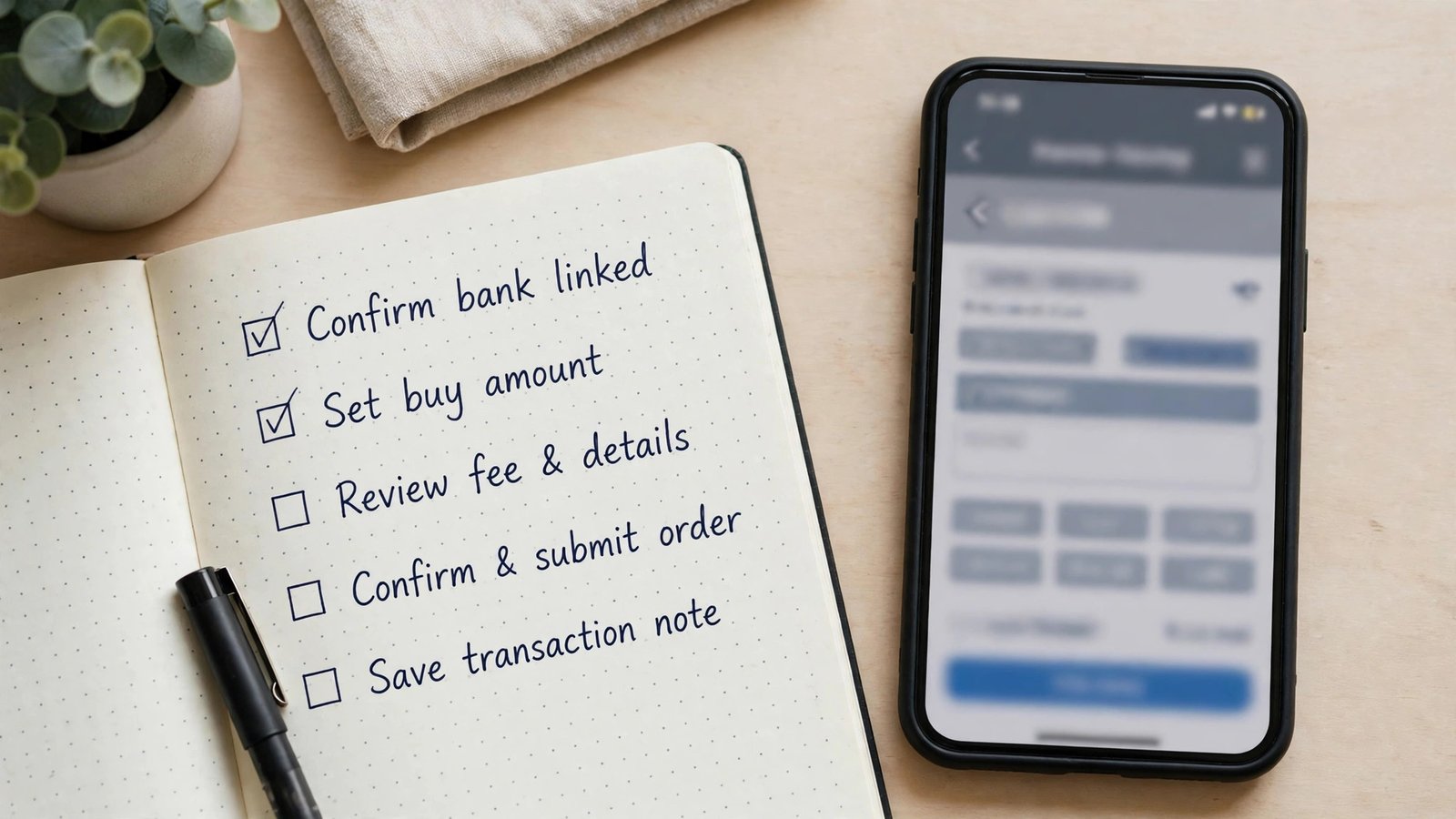
Enough theory. Here’s how to buy USDT for the first time, in order. Slow is fine.
Step 1: Pick one reputable platform. A large, licensed exchange or P2P market operating legally in your country — real support, a public fee page, a verifiable history. Avoid anything found through a random message or an ad promising guaranteed returns. They don’t exist.
Step 2: Verify your identity and turn on security. Complete the identity check, then turn on two-factor authentication with an authenticator app — not SMS alone, if you have the choice. Set a strong, unique password in a password manager. Not your notes app. Not a chat with yourself.
Step 3: Deposit a small test amount. The smallest you’re comfortable testing with. Confirm it arrived, note the fee. Already learning what the real cost looks like.
Step 4: Buy, and check the total cost. Write down what you paid in total, spread and fee included, then divide by the USDT received. That’s your real cost per USDT — the number you compare next time.
Step 5: Withdraw to a wallet you control — and test it. If you plan to hold the USDT, withdraw it to your own wallet — right network, small test first. Confirm the test arrived, then send the rest. Keep your recovery words offline: paper or steel, never a screenshot or cloud note. The guide on how to back up your seed phrase safely covers how, and why nobody can reset those words.
Step 6: Keep records. Date, amount, fees, platform, transaction IDs — you’ll need them for tax reporting, and they’re the fastest way to trace a missing transfer.
Six steps. The whole first purchase. Nothing clever.
Red Flags to Walk Away From
Most USDT losses aren’t technical failures. They’re social engineering — someone talking a person into a bad decision. Walk away if anyone offers USDT far below market price, if a “support agent” messages you first asking for your seed phrase or a remote-access code, or if a platform asks you to pay to “unlock” a withdrawal you already made. No genuine exchange does any of these things. None.
Be equally careful with links. Fake exchange sites are a common trap — one changed letter in the address, a convincing login page, and your credentials are gone. Type the address yourself, or use a bookmark you created. Don’t click a link from a message, an ad, or a search result you haven’t verified.
Finally, don’t trust a seller or platform for good reviews on its own website — reviews there prove nothing. Look for independent discussion, a verifiable company registration, and a fee page you can read before you create an account. The fine print lives on the Privacy Policy and Terms and Conditions pages; the Disclosure page explains how this site itself is funded.
Rushed? Pressured? Too cheap to be true? Stop. A genuine purchase will still be there in ten minutes.
Frequently Asked Questions
How to buy USDT for the first time?
Pick one licensed exchange or P2P market, verify your identity, turn on two-factor authentication. Deposit a small test amount, buy, check the total cost. Withdraw a small test to your own wallet on the right network, confirm it arrived, then send the rest. First time is for learning.
Is USDT the same as US dollars?
No. USDT is designed to track the dollar, but it’s a token issued by a company — not money in a bank account. It usually trades near one dollar, can drift slightly either way, and carries different risks than holding dollars.
Which network should I use for USDT?
No single right answer — it depends on your wallet and the fee at the time. The rule that never changes: sending network and receiving wallet must match exactly. In doubt, send a small test amount first. Always.
Is P2P trading safe?
It can be, on a reputable platform with escrow — if you follow the rules. Pay only through the recorded method, never move off-platform, never release escrow before payment is confirmed. Riskier than an exchange. Start small.
Do I need to verify my identity to buy USDT?
On most licensed exchanges, yes — verification is a normal regulatory requirement. A platform promising no checks for large amounts is a warning sign, not a benefit.
Can I lose USDT by sending it to the wrong address?
Yes. Crypto transactions are irreversible — the wrong address, or the wrong network, can mean permanent loss. That’s why the test-amount habit and the address check before every send matter. No undo button. Ever.
Should I keep USDT on the exchange or move it to my own wallet?
Depends on what you plan to do with it. Funds you trade often may stay on the exchange for convenience; funds you plan to hold are usually safer in a wallet you control — then you hold the keys. The About page sets out this site’s thinking on custody.
The Short Version
Buying USDT is straightforward once you separate the price from the cost. Check your country’s rules, pick one reputable platform, compare the total cost — deposit, spread, trading fee, network fee, conversion — not just the headline price. Choose the network carefully, test small first, and move funds you plan to hold into a wallet you control.
If anything feels rushed, pressured, or too cheap to be true? Stop. A genuine purchase will still be there in ten minutes.
Questions? The contact page is there.
Risk note: crypto transactions are irreversible — sending USDT to the wrong address or on the wrong network can mean permanent loss. Prices and fees change often, so check the live official fee page of any platform before you act. Educational only, not financial advice.
6 thoughts on “How to Buy USDT in Your Country (2026)”